

Relational Intelligence: For Conscious Therapeutic Engagement in the Service of Trauma Healing, by Dr. François Le Doze (Éditions Quantum Way), offers a new way of understanding and supporting deep traumatic wounds and traumatic dissociation.
Among the references that have shaped the Relational Intelligence® model, polyvagal theory holds a special place. Formulated by Stephen Porges from the 1990s onward, it has had a profound impact on many trauma clinicians because it offers a simple language for describing states that patients often recognize immediately: safety, mobilization, freeze, collapse, withdrawal, or the capacity for connection.
For RI, the point is not to turn polyvagal theory into a dogma. It is to recognize what it contributes to clinical practice: a way of identifying the states of the autonomic nervous system, of understanding safety as an embodied experience, and of giving co-regulation its full place in therapeutic work.
A clinical reading of autonomic states
Polyvagal theory seeks to move beyond the classic view of the autonomic nervous system as a simple opposition between the sympathetic system, associated with activation, and the parasympathetic system, associated with rest. Porges distinguishes several modes of response, organized around safety, mobilization, and immobilization.
When there is sufficient safety, a person can remain present, engaged, open to connection, and able to speak, listen, feel, and think. When danger is perceived, the nervous system can mobilize action responses: flight, fight, tension, agitation, hypervigilance. When these responses are not possible or are no longer enough, the organism can shift into states of immobilization, freeze, withdrawal, collapse, or shutdown.
For RI, this framework is useful because it gives therapist and patient a shared language for describing what is happening in the body and in the relationship. The patient is no longer simply “anxious,” “resistant,” “absent,” or “closed off.” They can be understood as engaged in a protective state. Their nervous system is seeking to preserve safety, even if this strategy has become costly or ill-suited to the present situation.
Neuroception: safety before thought
One of the most fruitful concepts in polyvagal theory is neuroception. It refers to the way the nervous system assesses, outside of conscious awareness, whether a situation, an environment, or a person is safe enough, ambiguous, or dangerous.
This assessment often precedes thought. A slightly firm voice, a silence, a look, a posture, or a certain relational distance can be perceived as threatening before the person can even explain what is happening. In someone marked by trauma, this automatic assessment can be strongly shaped by their past history. The body then reacts as if the old danger were present once again.
This idea echoes a key point in RI: a nervous system cannot always be reassured by arguments. Telling someone “you are not in danger” is not enough if their body perceives the situation as dangerous. Safety has to become a lived, embodied, and relational experience. That is why the therapist’s way of being—their pace, their tone, their presence, their engagement, their ability not to intrude—becomes a central element of the process.
From perceived safety to co-regulation

Polyvagal theory has helped bring a major clinical reality into view: the human nervous system regulates itself in relationship. From the very beginning of life, a child cannot maintain their internal states alone. They need another nervous system that is sufficiently available and regulated in order to find calm, organize their emotions, and gradually build their capacity for self-regulation.
RI takes up this idea and gives it a central place. When attachment disorders are in the foreground, the person cannot always access their Self from within right away. They cannot always calm themselves down alone, enter into relationship with what is suffering within them, or transform their state from the inside. The work then proceeds through co-regulation: a relational experience in which the patient’s nervous system receives, through the therapist’s presence, cues of safety it cannot yet generate on its own.
This co-regulation does not replace self-regulation. It often creates the conditions for it. In RI, the therapist does not seek to take the place of the patient’s Self. Through Conscious Therapeutic Engagement, they support the gradual emergence of a sense of safety that will later allow the patient to regain more stable access to themselves.
What this changes in the session

For the RI therapist, this perspective translates into close attention to the micro-movements of the nervous system. A gaze that turns away, a breath that catches, a change in tone, a posture that freezes, sudden agitation, a loss of presence, or an attack can signal an autonomic shift.
These signs are not just material to be interpreted. They guide therapeutic attunement. The therapist may slow down, change their tone of voice, lower their intensity, suggest a pause, adjust the distance, carefully name what they observe, or simply remain present without pushing the process further.
From this perspective, the work does not always begin with psychological content. Sometimes it begins by restoring a sufficient level of safety for that content to be approached. A person whose nervous system is mobilized for defense cannot always mentalize, narrate, associate, or integrate. The clinical priority then becomes meeting them in the state they are in, rather than asking them to function from a state that is not available.
A clinical framework, not a dogma
Polyvagal theory has had considerable influence in trauma-focused clinical settings because it offers an accessible grammar of autonomic states and relational safety. Several of its neuroanatomical and phylogenetic foundations, however, are debated within the scientific community. RI does not make its clinical value depend on the resolution of these debates: the practical usefulness of identifying states of safety, mobilization, and immobilization remains, whatever the outcome of the discussion about the underlying mechanisms. RI therefore draws on polyvagal theory as a clinical and teaching resource, and places it within a broader understanding of trauma, attachment, and dissociation.
Co-regulation and attachment disorders
Co-regulation takes on particular importance in attachment disorders. When early relationships were marked by absence, unpredictability, intrusion, fear, or insecurity, the connection with others can become deeply ambivalent. The patient may seek the therapist’s presence and protect themselves from it in the same movement. They may long to be met while perceiving the other’s engagement as dangerous.
In these situations, the therapeutic relationship is not merely a framework. It becomes the very place where the old danger can be encountered differently. The therapist offers a presence engaged enough not to repeat the absence, yet attuned enough not to repeat the intrusion. This relational precision lies at the heart of Conscious Therapeutic Engagement.
Co-regulation, then, is not simply soothing. It is a new experience of connection. It allows the patient gradually to discover that another person can be present without intruding, supportive without controlling, engaged without becoming threatening. It is from this experience that safety can begin to be rebuilt.
From co-regulation to self-regulation
One of RI’s key aims is to bring co-regulation and self-regulation together rather than setting them against each other. The purpose of co-regulation is not to make the patient dependent on the therapist. On the contrary, it aims to make more stable access to their own regulatory capacities possible.
When relational safety becomes sufficient, the patient can gradually differentiate from their defensive states. They can recognize that they are on alert, shutting down, cutting off, attacking, or collapsing. This recognition opens up a space: what was endured can begin to be observed, what was automatic can become more conscious, what was entirely governed by danger can begin to meet the present. It is in this transition that co-regulation connects with RI’s work on the Self: when the Self is not accessible from within, the therapeutic relationship becomes a temporary support that helps the nervous system regain enough safety for the patient gradually to become present to themselves again.
What this offers the patient
For someone who is suffering, understanding co-regulation can be profoundly relieving of guilt. Being unable to calm oneself down alone is not necessarily a weakness. It may be the consequence of a nervous system that has not had enough experience of reliable relational safety.
This understanding also restores dignity to the need for others. In a culture that values autonomy and self-control, it can be hard to accept that safety is built in relationship. Yet the human nervous system is profoundly relational: we learn to regulate ourselves because we were first regulated by others.
Relational Intelligence® takes this reality seriously. It holds that the therapeutic relationship can become one of the places where the nervous system regains the conditions necessary for transformation. It is not the relationship in itself that magically heals, but a relationship that is sufficiently attuned, conscious, and regulated—one capable of meeting defensive organizations without reinforcing them.
Relational Intelligence: For Conscious Therapeutic Engagement in the Service of Trauma Healing develops this perspective: a psychotherapy in which safety, the autonomic nervous system, and co-regulation are not peripheral elements but central dimensions of treating traumatic wounds and attachment disorders.
Frequently asked questions
What is polyvagal theory?
Formulated by Stephen Porges from the 1990s onward, it seeks to move beyond the classic view of the autonomic nervous system as a simple opposition between sympathetic and parasympathetic. Porges distinguishes several modes of response, organized around safety, mobilization, and immobilization.
What is neuroception?
It is the way the nervous system assesses, outside of conscious awareness, whether a situation, an environment, or a person is safe enough, ambiguous, or dangerous. This assessment often precedes thought: a voice, a silence, a look, or a posture can be perceived as threatening before the person can even explain what is happening.
Does co-regulation make the patient dependent on the therapist?
No. The purpose of co-regulation is not to make the patient dependent: on the contrary, it aims to make more stable access to their own regulatory capacities possible. It does not replace self-regulation; it creates the conditions for it.
Is polyvagal theory universally accepted?
Several of its neuroanatomical and phylogenetic foundations are debated within the scientific community. RI does not make its clinical value depend on the resolution of these debates: the practical usefulness of identifying states of safety, mobilization, and immobilization remains, whatever the outcome of the discussion about the underlying mechanisms.
Also in this series
Going further

Does this resonate with you?
The book Relational Intelligence: For Conscious Therapeutic Engagement in the Service of Trauma Healing, by Dr. François Le Doze, presents the model in detail.
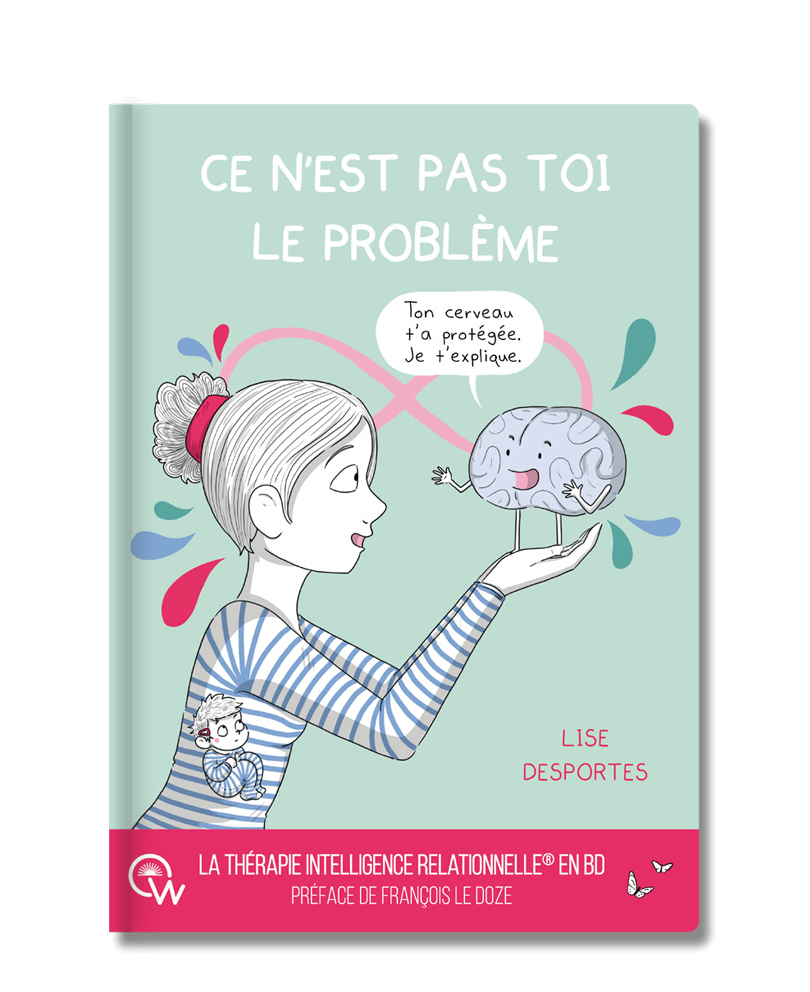
Looking for a simple resource to introduce these ideas to your patients?
It’s Not You That’s the Problem, the graphic novel by Lise Desportes with a foreword by François Le Doze (released August 26), makes these concepts accessible.
Are you a practitioner who would like to train in Relational Intelligence®?
References
Dana, D. (2018). The Polyvagal Theory in Therapy: Engaging the Rhythm of Regulation. W. W. Norton.
Porges, S. W. (1995). Orienting in a defensive world: Mammalian modifications of our evolutionary heritage. A polyvagal theory. Psychophysiology, 32(4), 301–318. https://doi.org/10.1111/j.1469-8986.1995.tb01213.x
Porges, S. W. (2011). The Polyvagal Theory: Neurophysiological Foundations of Emotions, Attachment, Communication, and Self-Regulation. W. W. Norton.
 Français
 English