

Relational Intelligence: For Conscious Therapeutic Engagement in the Service of Trauma Healing, by Dr. François Le Doze (Éditions Quantum Way), offers a new way of understanding and supporting deep traumatic wounds and traumatic dissociation.
No therapeutic practice is built all at once. It evolves through contact with patients, through unresolved questions, through the limits encountered in clinical work, and through the models that, at a given moment, make it possible to better understand what had until then been difficult to think through.
The evolution of François Le Doze’s practice is part of this movement. It begins in neurology, passes through Internal Family Systems, encounters attachment disorders and traumatic dissociation, and ultimately leads to the creation of Relational Intelligence®. Tracing this evolution shows that RI is not an abstract theoretical construct. It grew out of a gradual clinical shift: how can we support patients when direct access to the Self and to self-regulation is not enough to allow them to emerge from traumatic dissociation?
The starting point: the patient’s body

The starting point lies in the neurology departments of Caen University Hospital, where François Le Doze practiced for nearly thirty years. Neurology brought him into contact with patients suffering from diseases of the nervous system, but also with people whose illness profoundly altered their experience of themselves, of their bodies, and of their relationship to the world.
In this practice, illness never appears as a simple, isolated biological dysfunction. It affects a person in their history, their bodily experience, their emotional reactions, and their relationships. Very early on, this clinical experience gave rise to a question: how can we think about the body, the nervous system, psychological life, and personal history together?
This question led him to take an interest in the psychosomatic dimensions of illness. Stress, insecurity, traumatic experiences, and bodily responses cannot always be neatly separated. In some patients, the body seems to carry part of their history, sometimes with no narrative available, sometimes with no clearly formed memory. This line of inquiry would become one of the backdrops to his move toward psychotherapy.
Encountering IFS
The encounter with Internal Family Systems, developed by Richard Schwartz, was a first major turning point. IFS offers a new way of understanding psychological life: not as a homogeneous unit, but as a system made up of parts — some protective, others wounded — with the possibility for the Self to enter into relationship with them.
This discovery allowed François Le Doze to put words to clinical phenomena he had already been observing: patients can be internally divided, react from old patterns of organization, and carry fears, anger, shame, or protective strategies that no longer fit the present situation. IFS thus offered a powerful framework for understanding how parts can remain stuck in the past and how the Self can become an agent of inner regulation.
In his practice, this model proved particularly fruitful with patients whose psychological and physical suffering were intertwined. It offered a different way of approaching situations in which the symptom can be understood neither solely as a biological anomaly nor solely as a psychological problem.
François Le Doze then became a psychotherapist, and later an IFS trainer. He helped spread the model across French-speaking Europe and made the approach accessible to practitioners who had until then been able to access it mainly through the English-speaking world.
A first clinical limit
Over years of practice, however, a limit emerged. Some patients cannot always engage in the inner, self-to-self work that IFS offers. They may understand the model, identify parts, and notice certain internal reactions, yet be unable to establish a regulating relationship between their Self and what suffers or protects within them.
The problem is not simply the intensity of their emotional activation. A highly activated person can sometimes access self-regulation. The decisive point lies elsewhere: some patients do not feel safe enough with the therapist to explore what is being activated within them. The therapeutic relationship itself can trigger protective responses.
This limit particularly concerns attachment disorders. When insecurity has developed within early relationships, the therapist’s presence can be both necessary and dangerous for the patient’s system. The patient may need a secure relational engagement while experiencing that very engagement as a threat. In such situations, inner work with parts cannot be the sole starting point.
This observation marks an essential shift. The question is no longer only: how can we help the Self regain its role as inner leader? It becomes: how can we help the patient emerge from traumatic dissociation when it has organized itself around relational insecurity?
Implicit memory and traumatic dissociation
Attachment disorders also require us to take into account when the wounds were formed. Some early experiences are laid down before the child has a stable autobiographical narrative. They are not necessarily accessible as memories that can be told. Instead, they show up as bodily states, relational expectations, and protective responses — withdrawal, attack, freezing, or collapse.
Clinical work therefore cannot always look for an explicit memory, nor rely from the outset on a part that is clearly differentiated and recognized by the patient. In the most structural forms of traumatic dissociation, what presents first is sometimes an overall organization of the system: a way of perceiving relationships, of protecting oneself from closeness, of cutting oneself off from experience, or of experiencing safety as dangerous.
This understanding reflects François Le Doze’s dual background. His experience as a neurologist made him attentive to bodily mechanisms, neurophysiological states, and the effects of early experiences on the nervous system. His psychotherapeutic practice showed him that these patterns of organization cannot always be transformed through direct inner work. Sufficient relational safety must first be restored.
Co-regulation as a second shift
The second transformation of his practice came from Stephen Porges’s polyvagal theory, from the work of Deborah Dana and Deirdre Fay, and, more broadly, from the clinical practice of co-regulation. These contributions made it possible to think more precisely about how the therapeutic relationship can become a source of regulation.
IFS gives a central place to the inner relationship between the Self and the parts. RI retains this contribution but adds a decisive clinical element: when attachment disorders prevent direct access to self-regulation, the therapeutic relationship must become a place of safety established firmly enough for inner work to then begin.
Co-regulation is not merely about calming the patient. It aims to create the relational conditions in which traumatic dissociation can transform. The therapist then engages their presence, their bodily regulation, their rhythm, voice, distance, gaze, and attention, and their capacity to remain oriented within the relationship.
This co-regulation can also take place through metacognition. Together with the patient, the therapist makes explicit how the therapeutic relationship activates the patient’s protective responses. This is not about interpreting the patient from the outside, but about helping them recognize the relational dynamic at play: anticipation of intrusion, fear of abandonment, inability to receive safety, defense against the therapist’s engagement.
The birth of Relational Intelligence®
Out of this evolution, Relational Intelligence® was born at the end of 2017. The model was developed on the basis of IFS, but it was reorganized around a different clinical question: how can we enable emergence from traumatic dissociation, especially when it has developed within relational insecurity?
RI does not primarily seek to restore Self-leadership in the classical IFS sense. That restoration may be a major effect of the process, but it is not its starting point. The clinical aim is to allow what has remained organized around past threat to discharge, return to the present, and no longer govern the patient’s life from a situation that no longer exists.
Once this emergence from traumatic dissociation is sufficiently underway, RI can join IFS in its aim: the restoration of Self-leadership. But it adds an essential clarification. This Self-leadership is embodied: it is not limited to the Self’s inner relationship with the parts, but also concerns the person’s bodily presence, their relational safety, and their capacity to relate to others from the present.
A practice grounded in attunement
The evolution of this practice has led to a method that does not rely on a single protocol. The RI therapist seeks to determine which mode of work is clinically available.
When safety with the therapist is sufficient, the patient can access self-regulation. Their Self can enter into relationship with parts or dissociative organizations that have remained stuck in the past. These can then discharge and return to the present.
When this safety is not sufficiently established, co-regulation comes first. It always reaches the autonomic nervous system, but through two pathways. The direct bodily pathway works through attuning the therapist’s presence: rhythm, voice, distance, posture, orientation. The metacognitive pathway works through making explicit the relational dynamic that activates protective responses.
The criterion, then, is not the patient’s level of activation. The criterion is whether the patient can feel safe enough with the therapist to explore their inner experience and, from their Self, engage in a regulating relationship with what suffers or protects within them.
The therapist as a secure attachment figure

This evolution also transforms the therapist’s role. In RI, the therapist is not merely a neutral companion to the patient’s inner process. The therapist becomes a therapeutic attachment figure, provided their engagement is conscious, attuned, and regulated.
This position calls for specific vigilance. The therapist’s engagement can become a source of safety, but it can also activate the patient’s protective responses when the patient learned early on that relationships were dangerous. The therapist must therefore be able to recognize what their presence produces in the therapeutic relationship.
This is one of the meanings of Conscious Therapeutic Engagement. The therapist does not retreat behind a distant neutrality. Nor do they adopt an unregulated closeness. They engage their presence while remaining attentive to what that presence activates in the patient. They adjust their intervention on the basis of this clinical observation.
This requirement changes how practitioners are trained. Learning concepts or procedures is not enough. Therapists must develop their own capacity for regulation, their sensitivity to protective responses, their ability to use metacognition, and their capacity to remain engaged without that engagement being experienced as dangerous by the patient’s system.
A practice still in motion
The evolution of François Le Doze’s practice reveals a continuity: each stage arose from a clinical question left open by the previous one.
Neurology raised the question of the body, the nervous system, and the ill person. IFS opened up an understanding of psychological life in terms of parts and of the regulating role of the Self. Attachment disorders revealed the limits of direct access to self-regulation. Polyvagal theory, co-regulation, and metacognition made it possible to think more precisely about the role of the therapeutic relationship in emerging from traumatic dissociation.
This evolution is not a series of breaks. Rather, it reflects a gradual deepening of the same question: how can we support what, in a patient, has remained organized around a past threat, so that this organization can transform and return to the present?
Relational Intelligence® continues to be part of this dynamic. It does not present itself as a closed model, but as a structured clinical method, born of a practice that has confronted the limits of its own tools and remains attentive to the contributions of neuroscience, attachment theory, and contemporary psychotherapy.
What experience teaches about therapeutic time

One lesson runs through this evolution: transformation cannot be commanded. It requires certain conditions. In trauma, the first of these conditions is safety.
When a system remains organized around threat, it is not enough to understand what happened, nor to ask the patient to connect with themselves. Relational safety must first become sufficient for the defensive organization to be able to change. This safety cannot be imposed on the patient. It is built through the repeated attunement of the therapeutic relationship.
This perspective asks the therapist to give up immediate control over the process. The therapist does not force the emergence from traumatic dissociation, but establishes the conditions that make it possible: relational safety, co-regulation, metacognition, and gradual access to self-regulation as it becomes available.
It is in this spirit that François Le Doze now presents a synthesis of his journey in Relational Intelligence — For Conscious Therapeutic Engagement in the Service of Trauma Healing. The book traces the emergence of a model born in neurology, transformed by IFS, reshaped by clinical work with attachment disorders, and reorganized around a single aim: helping the patient emerge from traumatic dissociation and recover an embodied presence to themselves, to others, and to the world.
Frequently asked questions
When was Relational Intelligence® created?
The model was born at the end of 2017. It was developed on the basis of IFS, but reorganized around a different clinical question: how can we enable emergence from traumatic dissociation, especially when it has developed within relational insecurity?
Why are some wounds impossible to put into words?
Some early experiences are laid down before the child has a stable autobiographical narrative. They are not necessarily accessible as memories that can be told: instead, they show up as bodily states, relational expectations, and protective responses — withdrawal, attack, freezing, or collapse.
Is the therapist an attachment figure?
In RI, the therapist is not merely a neutral companion: the therapist becomes a therapeutic attachment figure, provided their engagement is conscious, attuned, and regulated. They neither retreat behind a distant neutrality nor adopt an unregulated closeness.
Can trauma healing be accelerated?
Transformation cannot be commanded: it requires certain conditions, the first of which is safety. This perspective asks the therapist to give up immediate control over the process. The therapist does not force the emergence from traumatic dissociation, but establishes the conditions that make it possible.
Also in this series
Going further

Does this resonate with you?
The book Relational Intelligence: For Conscious Therapeutic Engagement in the Service of Trauma Healing, by Dr. François Le Doze, presents the model in detail.
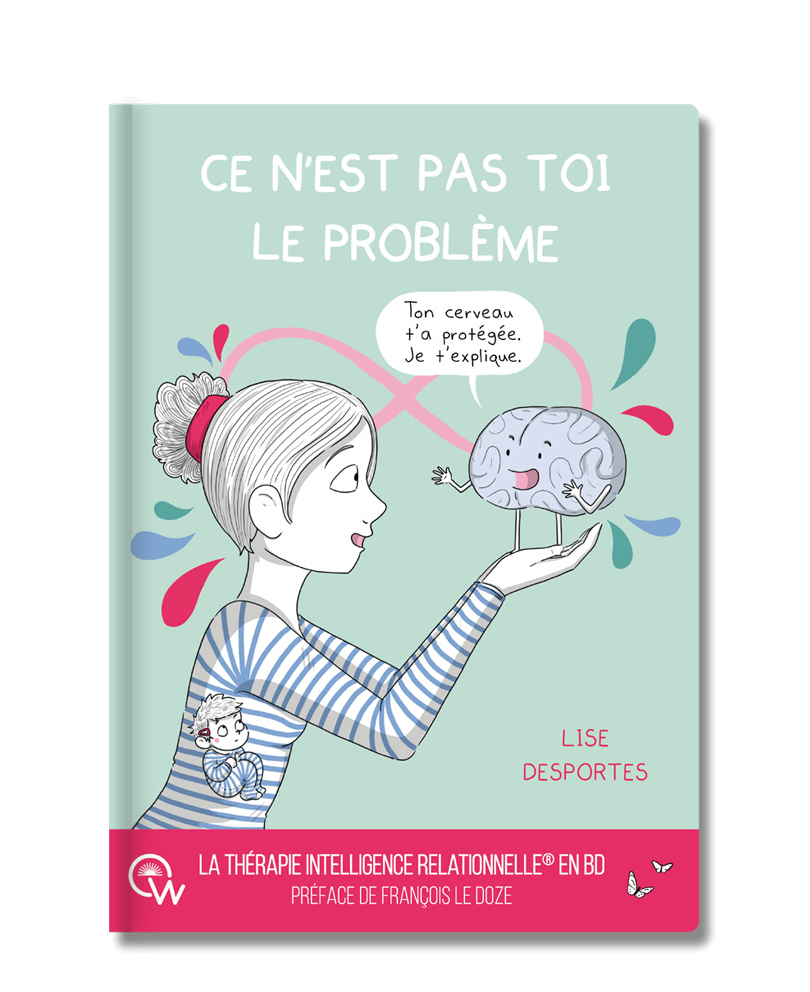
Looking for a simple resource to introduce these ideas to your patients?
It’s Not You That’s the Problem, the graphic novel by Lise Desportes with a foreword by François Le Doze (released August 26), makes these concepts accessible.
Are you a practitioner who would like to train in Relational Intelligence®?
References
Dana, D. (2018). The Polyvagal Theory in Therapy: Engaging the Rhythm of Regulation. W. W. Norton.
Fay, D. (2021). Becoming Safely Embodied: A Guide to Organize Your Mind, Body and Heart to Feel Secure in the World. Morgan James Publishing.
Porges, S. W. (2011). The Polyvagal Theory: Neurophysiological Foundations of Emotions, Attachment, Communication, and Self-Regulation. W. W. Norton.
Schwartz, R. C. (1995). Internal Family Systems Therapy. Guilford Press.
Schwartz, R. C., & Sweezy, M. (2020). Internal Family Systems Therapy (2nd ed.). Guilford Press.
 Français
 English