


Relational Intelligence®
For Conscious Therapeutic Engagement
in the Service of Trauma Healing...
Why Isn’t Understanding Enough to Heal? And Under What Conditions Can the Therapeutic Relationship Bring About Change Where Insight Alone Falls Short?
François Le Doze, neurologist and psychotherapist, offers a rigorous, clinically grounded answer rooted in practice.
Le livre est disponible dès aujourd’hui : en le commandant, vous soutenez concrètement sa diffusion auprès des libraires.
When a person has been wounded by trauma, they may remain caught in reactions they do not always understand: fear, withdrawal, anger, shame, dissociation, hypervigilance or difficulty trusting. These reactions are not mere symptoms to be corrected. They are often the traces of a deep protective organization, set up to survive when safety was no longer accessible.
Relational Intelligence® starts from this reality: we do not heal only by understanding what happened, but by rediscovering, in the body and in the relationship, an experience of safety stable enough for what has become frozen to gradually transform.
The originality of the model lies in placing the therapeutic relationship at the heart of this process. It is not merely a caring framework or moral support, but a genuine lever for regulation, making it possible to come into contact with the wounds, the defensive responses and the forms of dissociation organized around insecurity. To this end, RI relies on Conscious Therapeutic Engagement: a way for the therapist to be present and attuned, attentive to the state of the patient’s nervous system as well as their own, in order to accompany the person as closely as possible to their experience, without pushing them beyond what they can integrate.
By bringing together relationship, body, the neuroscience of trauma, attachment theory and an understanding of dissociation, Relational Intelligence® offers a clear framework for transforming chronic insecurity into inner safety, capacity for connection and regained freedom.
This book is intended for helping professionals as well as informed readers. It also opens onto a training program designed to pass on the landmarks, the stance and the clinical practice of the RI model.
What you will find in this book
Part I
The genesis of the model
François Le Doze’s clinical journey and the clinical dead ends that led to the emergence of the model
Part II
The theoretical foundations
The structuring elements of the model linked to concrete clinical observations
Part III
Clinical implementation
9 detailed teaching vignettes, including a complete session, and 3 clinical cases in university addiction medicine
Part IV
RI in dialogue
Positioning RI within the field of psychotherapies, comparison with IFS, EMDR, DBR, Gestalt, NBIP and research perspectives
Already trained in RI?
The training gave you the stance and the experience. This book gives you the words.
This is the first time François Le Doze has set out in writing the complete architecture of the model, including concepts you have experienced in training without necessarily having the language to explain them to your peers, your supervisors or your patients.
What you will find in particular:
- The first written formalization of the bubble — with its neurobiological elements and a clinical protocol for treating it
- The four levels of metacognition detailed and differentiated, each with its specific clinical function
- A rigorous framework on the risks of CTE — transference, countertransference, therapeutic neutrality
- A comparative mapping of RI alongside IFS, EMDR, DBR, Gestalt and NBIP
- Three documented clinical cases in university addiction medicine
- The research perspectives currently underway: PARTS, DBR and TPV studies
New to RI?
Every trauma therapist has met this dead end: a patient who understands everything — their history, their mechanisms, their wounds — and yet does not transform. This book starts from there.
It explains why understanding is not enough, and under what conditions the therapeutic relationship can bring about change where meaning fails. No prior knowledge of the RI model required.
What will help you enter the book:
- A prologue that is immediately recognizable for any trauma practitioner, whatever your approach
- The genesis of the model: Le Doze’s journey from neurology to psychotherapy, from IFS to RI
- The two-brain model: a clear and accessible neuroanatomical model
- Conscious Therapeutic Engagement: what sets RI apart from all other integrative approaches
- Nine teaching vignettes including a complete session: what the model does, not just what it is
- RI in dialogue with IFS, EMDR, DBR and Gestalt: to situate the model within what you already know
Professor Cyril Tarquinio
University Professor at the University of Lorraine. Expertise in psychotherapy, EMDR, adversity theory and psychotrauma
Some books describe a method. Others reveal a deeper shift in the history of a practice. This work by François Le Doze belongs to the second category.
Professor Cyril Tarquinio
University Professor at the University of Lorraine. Expertise in psychotherapy, EMDR, adversity theory and psychotrauma
"We do not heal only by understanding what happened to us; we transform when something, in the body and in the relationship, can finally experience that danger is no longer the only possible reality."
See also, in connection with the book’s release...
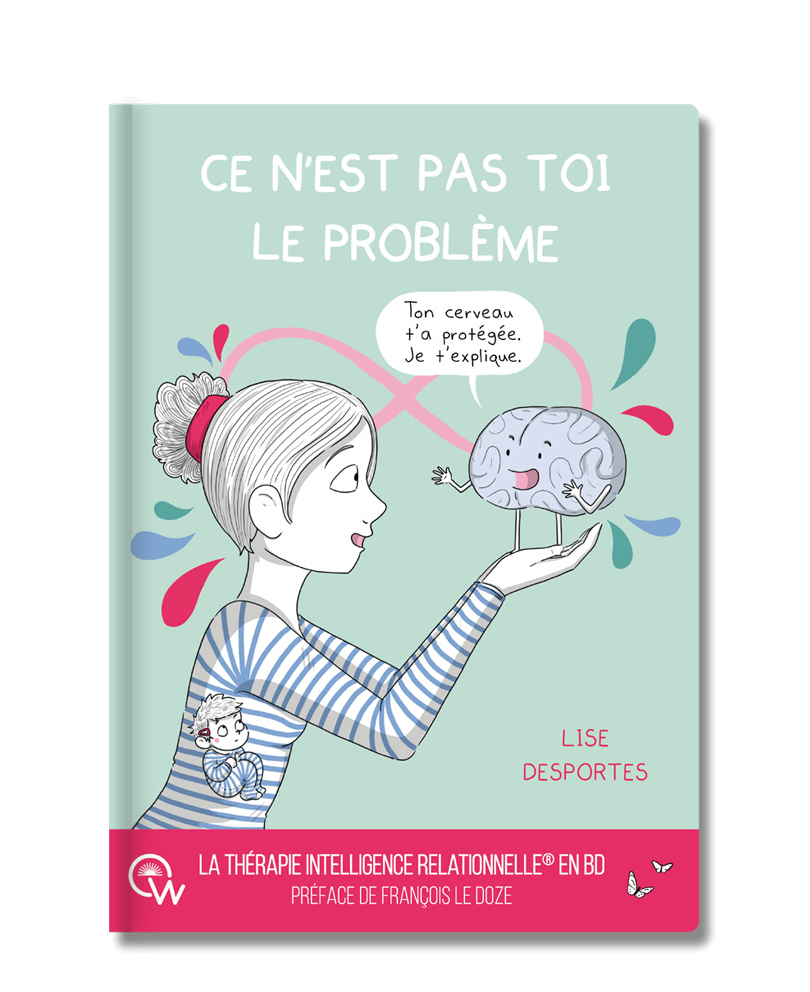
Lise Desportes · Foreword: François Le Doze
It’s Not You That’s the Problem — Your Brain Protected You. Let Me Explain.
A psychoeducation tool for practitioners and their patients, to understand how our experiences shape our nervous system and our relationships, and how RI therapy enables deep transformation through the experience of safety.
Your questions about the book
No. The book traces the genesis of the model and lays all the theoretical and clinical foundations. It can be read without prior training.
Helping professionals — psychologists, psychotherapists, psychiatrists, physicians — as well as informed readers interested in the neuroscience of trauma and integrative approaches.
The book sets out the theoretical and clinical foundations of the model. The training passes on the stance and the practice through experience — it goes beyond what reading alone can provide. The two are complementary.
Yes. The third part is entirely devoted to clinical implementation, with nine detailed teaching vignettes including a complete session, and three clinical cases from a university addiction medicine department.
Yes, in ePub format — compatible with Kindle, Kobo and other e-readers — from October 14.
Yes. The book is distributed in Belgium, Switzerland and Canada. For other countries, it can be ordered via Amazon.
Yes. Self Thérapie Formation offers certified training in the RI model for mental health professionals.
Yes — videos, interviews and podcasts are available in the Resources section of the website. The graphic novel “ It’s Not You That’s the Problem”, by Lise Desportes, with a foreword by François Le Doze, is also an accessible gateway to the model.
Yes, Amazon delivers to most European Union countries.
You receive the book from October 14 and actively support its distribution to bookshops.
 Français
 English